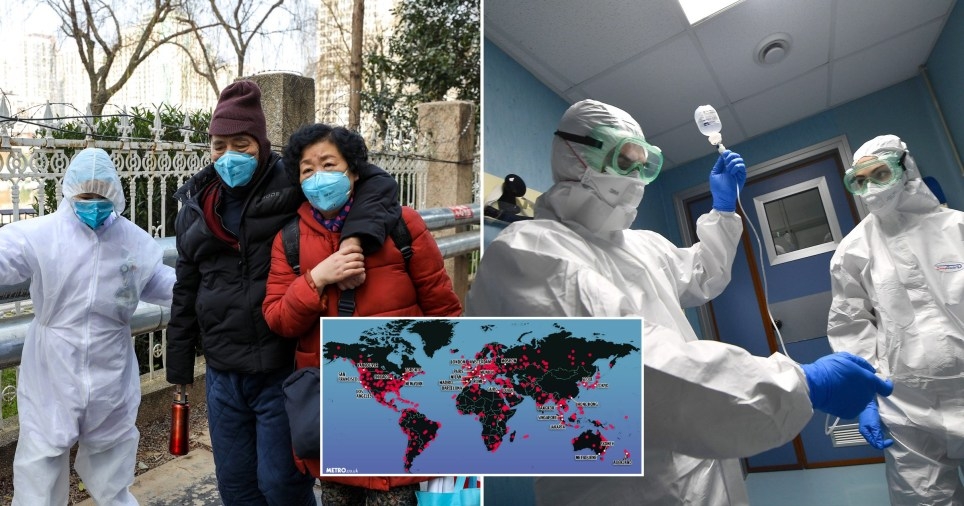
The new coronavirus has been declared a global emergency by the World Health Organization, as the outbreak continues to spread outside China.
"The main reason for this declaration is not what is happening in China but what is happening in other countries," said WHO chief Tedros Adhanom Ghebreyesus.
The concern is that it could spread to countries with weaker health systems.
Meanwhile, the US has told its citizens not to travel to China.
The State Department issued a level four warning - having previously urged Americans to "reconsider" travel to China - and said any citizens in China "should consider departing using commercial means".
- US advises against all travel to China over virus
- Cement mixers become celebrities in China lockdown
At least 213 people have died in China - mostly in Hubei province where the virus emerged - with almost 10,000 cases nationally.
The WHO said there had been 98 cases in 18 other countries, but no deaths.
Most international cases are in people who had been to the Chinese city of Wuhan in Hubei.
However, there have been eight cases of human-to-human infection - in Germany, Japan, Vietnam and the United States.
Speaking at a news conference in Geneva, Dr Tedros described the virus as an "unprecedented outbreak" that has been met with an "unprecedented response".
He praised the "extraordinary measures" Chinese authorities had taken, and said there was no reason to limit trade or travel to China.
"Let me be clear, this declaration is not a vote of no confidence in China," he said.
But various countries have taken steps to close borders or cancel flights, and companies like Google, Ikea, Starbucks and Tesla have closed their shops or stopped operations.
The US Commerce Secretary, Wilbur Ross, has said the outbreak could "accelerate the return of jobs to North America".
How unusual is this declaration?
The WHO declares a Public Health Emergency of International Concern when there is "an extraordinary event which is determined… to constitute a public health risk to other states through the international spread of disease".
It has previously declared five global public health emergencies:
- Swine flu, 2009 -The H1N1 virus spread across the world in 2009, killing more than 200,000 people
- Polio, 2014 - Although closer than ever to eradication in 2012, polio numbers rose in 2013
- Zika, 2016 - The WHO declared Zika a public health emergency in 2016 after the disease spread rapidly through the Americas
- Ebola, 2014 and 2019 - The first emergency over the virus lasted from August 2014 to March 2016 as almost 30,000 people were infected and more than 11,000 died in West Africa. A second emergency was declared last year as an outbreak spread in DR Congo
How is China handling the outbreak?
A confirmed case in Tibet means the virus has reached every region in mainland China. According to the country's National Health Commission, 9,692 cases have tested positive.
The central province of Hubei, where nearly all deaths have occurred, is in a state of lockdown. The province of 60 million people is home to Wuhan, the heart of the outbreak.
The city has effectively been sealed off and China has put numerous transport restrictions in place to curb the spread of the virus.
People who have been in Hubei are also being told to work from home until it is considered safe for them to return.
The virus is affecting China's economy, the world's second-largest, with a growing number of countries advising their citizens to avoid all non-essential travel to the country.
How is the world responding?
Voluntary evacuations of hundreds of foreign nationals from Wuhan are under way.
The UK, Australia, South Korea, Singapore and New Zealand are expected to quarantine all evacuees for two weeks to monitor them for symptoms and avoid contagion.
- Coronavirus misinformation spreads online
- Diary of a life in locked-down Wuhan
- Virus evacuees criticise Australia quarantine plan
Australia plans to quarantine its evacuees on Christmas Island, 2,000km (1,200 miles) from the mainland in a detention centre that has been used to house asylum seekers.
In other recent developments:
- Italy suspended flights to China after two Chinese tourists in Rome were diagnosed with the virus; earlier 6,000 people on board a cruise ship were temporarily barred from disembarking
- In the US, Chicago health officials have reported the first US case of human-to-human transmission. Around 200 US citizens have been flown out of Wuhan and are being isolated at a Californian military base for at least 72 hours
- Russia has decided to close its 4,300km (2,670-mile) far-eastern border with China
- Two flights to Japan have already landed in Tokyo. Japan has now raised its infectious disease advisory level for China
- Some 250 French nationals have been evacuated from Wuhan
- India has confirmed its first case of the virus - a student in the southern state of Kerala who was studying in Wuhan
- Israel has barred all flight connections with China
- Papua New Guinea has banned all visitors from "Asian ports"
BBC

Russia's unmanned Luna-25 spacecraft has crashed into the Moon after spinning out of control, officials say.

Donald Trump has confirmed that he will not take part in Republican presidential debates with his rivals in the race for the White House.