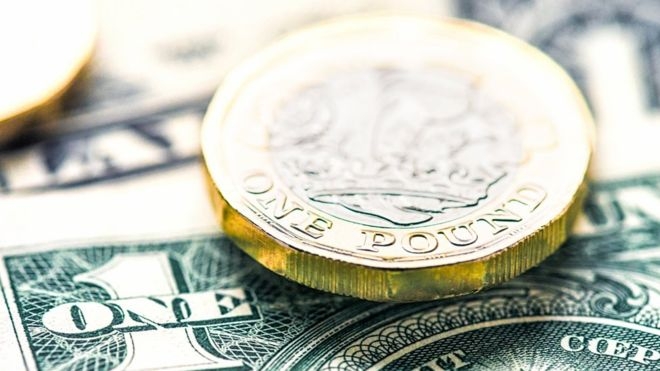
The pound has fallen to its lowest level against the dollar since 1985, as the spread of the coronavirus pandemic spooks investors.
It is currently trading at $1.15, a fall of almost 5% in just one day.
It comes as financial markets tumbled again after major stimulus plans failed to quell fears about the economic impact of the virus.
The Dow and S&P 500 fell more than 7% in early afternoon, triggering an automatic temporary halt to trade.
The pound's weakness could partly stem from questions over how the UK government plans to pay for the emergency economic measures it has introduced, says Neil Wilson, chief analyst for Markets.com.
"This is the worst sustained period of sterling selling that I can recall," he says. "The government's massive fiscal package undoubtedly means more borrowing for the UK economy - how do we pay for all this?"
Meanwhile, the FTSE 100 index of top UK firms closed down 4%, with aerospace and travel firms among the hardest hit.
'Economic fight'
UK Chancellor Rishi Sunak revealed a £350bn stimulus package for UK firms on Tuesday, including £330bn of business loan guarantees.
It included aid to cover a business rates holiday and grants for retailers and pubs, while help for airlines is also being considered.
Despite this, investors are still flocking to the comparatively safer dollar, says Ranko Berich, head of Market Analysis at Monex Europe.
"The UK's response to the incoming coronavirus shock has been about as aggressive as possible in terms of monetary and fiscal policy, but this has done nothing to help sterling.
"Idiosyncratic factors such as the UK's monetary and fiscal response or Brexit are beside the point: this is about the US dollar, which is proving unstoppable as global financial markets stare into the abyss of crisis-like conditions," he said.
Investors say rescue measures can only blunt the pain, as countries close borders and order mass closures, bringing most economic activity to a halt.
The US on Tuesday outlined a $1tn (£830bn) proposal to support the world's biggest economy, which is expected to include direct payments to families, small business assistance and bailouts for airlines and other industries.
In the US, large companies have already announced more than 3,600 job cuts or furloughs, according to research firm Challenger, Gray & Christmas. The firm said some nine million other jobs at local bars and restaurants could also be at risk.
Car factories in the UK and elsewhere have halted production, while the slowdown has pushed other firms such as Laura Ashley and Flybe into administration.
Concerns about the damage have spurred a widespread sell-off. France's CAC 40 fell more than 6% while Germany's Dax dropped more than 5%.
Oil prices also plunged to levels not seen since the early 2000s, as demand contracts sharply, but exporters boost supply. The declines have even hit gold and government debt, which are typically considered less risky assets.
Asian markets have fared better than the US and Europe in recent days, but were also lower. Japan's benchmark Nikkei 225 ended Wednesday 1.7% lower, the Hang Seng in Hong Kong fell by 3.3%, and China's Shanghai Composite lost 1.8%.
BBC

Russia's unmanned Luna-25 spacecraft has crashed into the Moon after spinning out of control, officials say.

Donald Trump has confirmed that he will not take part in Republican presidential debates with his rivals in the race for the White House.