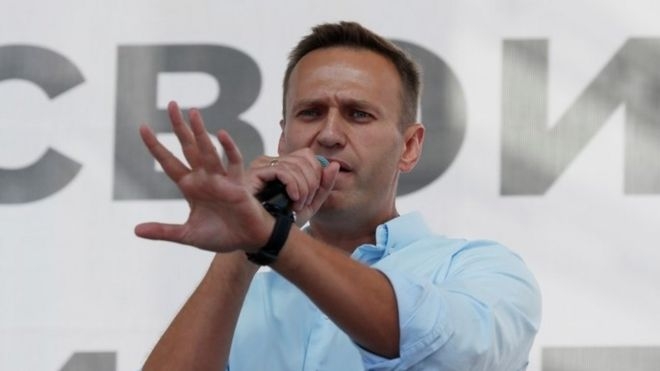
Russian doctors say leading opposition figure Alexei Navalny - who supporters believe was poisoned - remains too ill to be moved to Germany for treatment.
Mr Navalny has been in a coma since Thursday when he fell ill on a flight. His supporters called the doctors' decision "a direct threat to his life".
The doctors say no poison was found in his body.
The prominent critic of President Vladimir Putin has consistently exposed official corruption in Russia.
He has served multiple jail terms.
His team suspects a poisonous substance was put in his tea at an airport cafe in the city of Tomsk as he prepared to fly to Moscow.
German doctors have now been given access to him in hospital, one of his aides told reporters.
At a news conference in Berlin, Leonid Volkov said a medically equipped plane sent from Germany was still waiting for him in the Siberian city of Omsk, where he is in hospital.
In a preliminary diagnosis on Friday, doctors said his condition might be the result of a "metabolic disorder" caused by low blood sugar.
The head doctor at the hospital treating Mr Navalny in Omsk in Siberia said the patient was too unstable to be transferred and that legal questions would need to be resolved before any move.
Mr Navalny's team said it was "deadly" for him to remain in the hospital.
"The ban on the transportation of Navalny is an attempt on his life," his spokeswoman Kira Yarmysh wrote on Twitter.
What's happening with efforts to move him?
The Berlin-based Cinema for Peace Foundation organised an air ambulance to pick up Mr Navalny and bring him back to Berlin, where it said the Charite hospital was ready to treat him.
It said the aircraft had medical equipment and a team specialised in treating coma patients on board.
The Cinema for Peace Foundation was founded by activist and filmmaker Jaka Bizilj. In 2018, it arranged for the treatment of Pyotr Verzilov - an activist with Russian protest group Pussy Riot - who had symptoms of poisoning.
The air ambulance for Mr Navalny arrived in Omsk on Friday morning.
Mr Navalny's wife Yulia has written to President Putin asking him to allow her husband to be moved.
Mr Putin's spokesman Dmitry Peskov said on Thursday that the Kremlin would help move Mr Navalny abroad if necessary and wished him a "speedy recovery". On Friday, he said transporting him by air "may pose a threat to his health".
The hospital said it would not hand Mr Navalny over. Yulia Navalnaya told reporters she believed the doctors were seeking to cover up her husband's poisoning.
"We certainly believe that it is done to make sure that a chemical substance which is in Alexei's body will dissolve," she said. "We certainly cannot trust this hospital".
Timeline: Navalny targeted
April 2017: He was taken to hospital after an antiseptic green dye was splashed on his face in Moscow. It was the second time he was targeted with zelyonka ("brilliant green" in English) that year. "It looks funny but it hurts like hell," he tweeted following the attack.
July 2019: He was sentenced to 30 days in prison after calling for unauthorised protests. He fell ill in jail and doctors said he had suffered an acute allergic reaction, diagnosing him with "contact dermatitis". His own doctor suggested he might have been exposed to "some toxic agent" and Mr Navalny said he thought he might have been poisoned.
December 2019: Russian security forces raided the offices of his Anti-Corruption Foundation, taking laptops and other equipment. CCTV footage showed officials using power tools to get through the door. Earlier that year, his organisation was declared a "foreign agent".
The German government said it was in touch with officials in Moscow to find a solution to the "humanitarian emergency".
The EU called for Mr Navalny to be "safely and speedily transferred abroad" and urged a "swift, independent, transparent investigation" into the suspected poisoning.
The US Embassy in Russia said that, "if true", the suspected poisoning of Mr Navalny "represents a grave moment for Russia".
How did he end up in hospital?
Mr Navalny fell ill during a flight from Tomsk to Moscow and his plane made an emergency landing in Omsk.
"Alexei has toxic poisoning," Ms Yarmysh tweeted.
Video footage on social media showed Mr Navalny being taken on a stretcher to an ambulance on the airport runway.
Other disturbing video appeared to show a stricken Mr Navalny in pain on the flight. Passenger Pavel Lebedev said he heard the activist "screaming in pain".
Another photograph on social media purported to show Mr Navalny drinking from a cup at a Tomsk airport cafe.
What's the latest on his condition?
Alexander Murakhovsky, the head doctor at the Siberian hospital, said a preliminary diagnosis of a "metabolic disorder" had been given.
"This could have been caused by a sharp fall in blood sugar levels, which caused a loss of consciousness," he said.
The hospital says its tests have found no traces of poison in Mr Navalny's blood so far. Mr Murakhovsky said traces of a common industrial chemical used in plastic cups had been found on Mr Navalny's clothes and fingers.
He earlier said there were five possible diagnoses.
Deputy head doctor Anatoly Kalinichenko said "poisoning as a diagnosis remains on the back burner" but that doctors did not believe poisoning was responsible.
Ivan Zhdanov, an associate of Mr Navalny, said on Friday he had been told by a transport police official that a "deadly" substance had been used, which posed a threat not only to the opposition figure's life, but also those around him, meaning that protective suits should be worn.
State news agency Tass cited a police officer saying: "We can't rule out that he drank or took something himself". Ms Yarmysh dismissed this as "complete rubbish".
BBC

Russia's unmanned Luna-25 spacecraft has crashed into the Moon after spinning out of control, officials say.

Donald Trump has confirmed that he will not take part in Republican presidential debates with his rivals in the race for the White House.