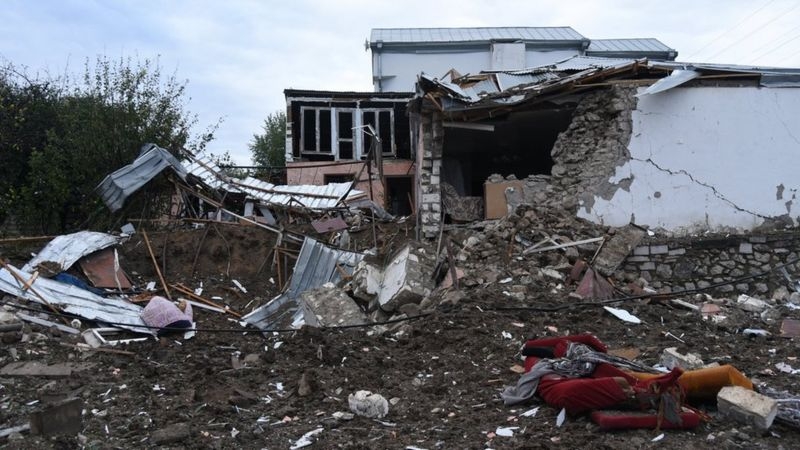
There have been reports of fresh fighting between Armenia and Azerbaijan, just hours after a ceasefire came into force.
Blasts hit Stepanakert, the capital of disputed region Nagorno-Karabakh, on Saturday evening, say eyewitnesses and Armenian media.
Both sides have previously accused the other of continuing bombardments.
After two weeks of fighting, the two countries agreed to a temporary truce during talks in Moscow on Friday.
The leader of Nagorno-Karabakh region, Arayik Harutyunyan, told AFP news agency the situation was "calmer" on Sunday but warned the truce was precarious.
A residential apartment block in Azerbaijan's city of Ganja was destroyed overnight in what officials say was an Armenian missile strike. Officials say seven people were killed and dozens injured.
Armenia has called reports of the strike "an absolute lie".
The now-fragile ceasefire was to allow the two countries to exchange prisoners and recover bodies from the recent bout of fighting.
More than 300 people have died and thousands been displaced since the latest violence in the long-running conflict broke out on 27 September.
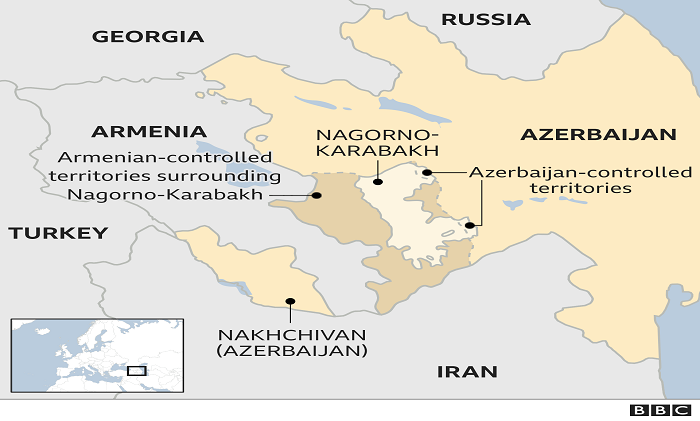
Nagorno-Karabakh is run by ethnic Armenians although it is officially part of Azerbaijan.
The two former Soviet republics have blamed each other for the latest outbreak of violence - the worst in decades.
Meanwhile US celebrity Kim Kardashian West, who is of Armenian heritage, announced on social media that she was donating $1m (£770,000) to a fund for Armenian victims of the conflict.
How did the ceasefire come about?
It was agreed after 10 hours of talks in the Russian capital, Moscow. Russian Foreign Minister Sergei Lavrov said the two countries would now begin "substantive" talks.
However, Armenian Foreign Minister Zohrab Mnatsakanyan later described the talks as "rather difficult" and said Armenia wanted Nagorno-Karabakh to be recognised internationally as an independent state.
Self-declared Karabakh officials echoed this call and accused Azerbaijan of using ceasefire talks as cover to prepare fresh attacks.
Meanwhile, Azeri Foreign Minister Jeyhun Bayramov said not enough pressure had been put on Armenia during the talks and the situation in Nagorno-Karabakh could not remain as it was.
Azerbaijan expected to take control of more territory and the ceasefire would last only as long as it took for the Red Cross to arrange for bodies to be exchanged, he said.
Turkey, which backs Azerbaijan, said the truce was Armenia's "last chance" to withdraw forces from the disputed territory.
Russia has a military base in Armenia and both are members of the Collective Security Treaty Organization (CSTO) alliance.
However, Moscow also has good relations with Azerbaijan.
What happened after the ceasefire came into force?
Armenia's defence ministry said Azeri forces had launched an attack five minutes after the truce had been due to come into effect, with ethnic Armenian forces responding. Azeri forces were also bombarding a town, the defence ministry said.
Meanwhile Azerbaijan's defence ministry said Armenia was "blatantly violating the ceasefire regime" and firing into the Azeri regions of Terter and Agdam. Armenia denied this.
There was also intense fighting ahead of the ceasefire. The self-declared ethnic Armenian authorities in Nagorno-Karabakh said Azerbaijan fired missiles at civilian neighbourhoods of the main city, Stepanakert, while Armenia accused Azeri forces of intensifying drone strikes.
For its part, Azerbaijan said Armenia had shelled populated areas near Nagorno-Karabakh and said it was returning fire.
On Thursday, Armenia accused Azerbaijan of deliberately shelling a historic cathedral in Nagorno-Karabakh. Pictures showed serious damage at the Holy Saviour Cathedral in Shusha city (known as Shushi in Armenian).
At the same time, Azerbaijan said that its second-largest city, Ganja, and the region of Goranboy had been shelled by Armenian forces, with at least one civilian killed.
Speaking to the BBC earlier this week, Armenian Prime Minister Nikol Pashinyan warned of a "genocide" in the region, and said it was "Armenia, land of Armenians".
The clashes have displaced half of Nagorno-Karabakh's population - about 70,000 people - officials said.
Stepanakert has suffered several days of shelling with residents sheltering in basements and much of the city left without power.
Armenia and Azerbaijan went to war over Nagorno-Karabakh in 1988-94, eventually declaring a ceasefire. However, they never reached a settlement in the dispute.
BBC

Russia's unmanned Luna-25 spacecraft has crashed into the Moon after spinning out of control, officials say.

Donald Trump has confirmed that he will not take part in Republican presidential debates with his rivals in the race for the White House.