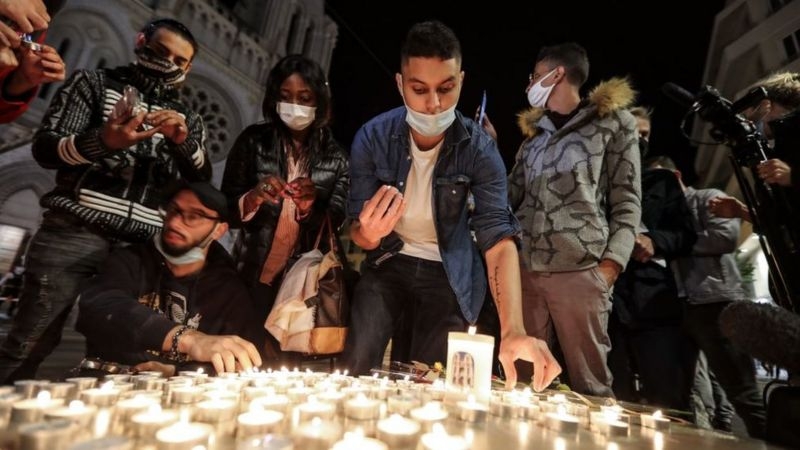
The southern French city of Nice was in mourning on Friday for the three people stabbed to death in a suspected jihadist attack at a church.
A makeshift memorial has been set up outside the Notre-Dame basilica, where people have placed flowers and lit candles for the victims.
French President Emmanuel Macron said Thursday's stabbings were an "Islamist terrorist attack".
He is to hold an emergency meeting with senior ministers on Friday.
Meanwhile, security has been stepped up at places of worship and schools across France following two similar attacks within two weeks. Earlier this month a teacher was beheaded in a Paris suburb after showing controversial cartoons of the Prophet Muhammad to some of his pupils.
Mr Macron's subsequent defence of the right to publish the cartoons has stoked anger in several Muslim-majority countries.
Following the latest attack, police shot and wounded the suspected knifeman, identified as a 21-year-old Tunisian who had only recently arrived in Europe. He is said to be in a critical condition in hospital.
What do we know about the victims?
The two women and a man were attacked inside the basilica on Thursday morning before the first Mass of the day.
Two died inside the church, one of them a 60-year-old woman who was "virtually beheaded" close to the font. She has not been named.
French media have named one victim as 55-year-old Vincent Loquès, a devout Catholic who had reportedly worked at the basilica for more than 10 years.
Mr Loquès, a father of two loved by many of the church's regulars, was opening the building when the attacker slit his throat, police say.

The third victim was named by the Brazilian foreign ministry as Simone Barreto Silva, a 44-year-old mother of three born in Salvador on Brazil's north-eastern coast. She had lived in France for 30 years.
She fled to a nearby cafe with multiple stab wounds but died shortly afterwards. "Tell my children that I love them," she told those who tried to help her, according to French media.
On Friday morning, priest Philippe Asso stood on the church steps with other mourners before walking in with a wreath to the victims.
Others gathered outside the church to pay their respects.
Nice resident Frederic Lefèvre, 50, said he knew Mr Loquès.
"This is a tragedy once again," he said. "We're a free country, we have demonstrated freedom to all countries of the world. Today, this freedom is closing in on us. Life needs to be lived for everyone."
Marc Mercier, 71, called the killings a "catastrophe".
"It's appalling. It's been years that we've been saying that fear should shift to the other side (attackers) but it is still the same."

Peace seems far from reach
Outside the doors of Notre-Dame, the bright light of a Nice morning rose on small collections of flowers and candles left by local residents last night. The message on one bouquet reads: "Nice is still standing. Rest in peace."
For the living, though, peace seems far from reach. We met the treasurer of Notre-Dame, Jean-Francois Gourdon, outside the church. He knew Vincent Loquès well. He told me how he'd left Vincent in the church on Thursday morning, just before the attack, and returned to find him dead - a large wound to his throat. Telling his wife was awful, he said. She'd been planning celebrations for his birthday this week.
This is the third terrorist attack France has suffered in just over a month. After a knife attack on staff at a television company in Paris, and the beheading of a history teacher in a nearby suburb, there are now three more victims.
President Macron has said the country "will never give in" to "Islamist terrorist attacks". But this is just one crisis among others. France has seen a sharp surge in coronavirus infections this month and - despite real fears for the economy - is re-entering national lockdown from today.
For the next month at least, the rhythms of life will be disrupted - and in Nice, the mourning will take place behind closed doors.
What do we know about the suspect?
Police sources named the man as Brahim Aouissaoui. Prosecutors said he had arrived by boat on the Italian island of Lampedusa as a migrant last month and after quarantining had been ordered to travel on.
He arrived in Nice by train and had no papers except for a Red Cross document from Italy, investigators said. A Tunisian official said he had not been listed as a suspected militant.
Witnesses said the attacker repeatedly shouted "Allahu Akbar" (God is greatest) before being shot by police.
A Koran, two telephones and a 30cm (12-inch) knife were found on him, said French chief anti-terrorist prosecutor Jean-François Ricard.
"We also found a bag left by the attacker. Next to this bag were two knives that were not used in the attack," he added.
In another development, a 47-year-old man believed to have been in contact with the suspect was detained by police late on Thursday, French media reported.
What has the official reaction been?
On Friday, Interior Minister Gerald Darmanin said France was "at war" with the political ideology of militant Islamism.
"We are at war... against an enemy who is both an internal enemy and an external enemy, an ideology because we are not at war against a religion," he said. "We are at war against an ideology, Islamist ideology."
Speaking after visiting Nice, Mr Macron told reporters: "If we are attacked once again it is for the values which are ours: freedom, for the possibility on our soil to believe freely and not to give in to any spirit of terror.
"I say it with great clarity once again today: we won't surrender anything."
He said the number of soldiers being deployed to protect public places - such as churches and schools - would rise from 3,000 to 7,000.
France has raised its national security alert to the highest level.

A timeline of recent attacks in France
October 2020: French teacher Samuel Paty is beheaded outside a school in a suburb of Paris
September 2020: Two people are stabbed and seriously hurt in Paris near the former offices of Charlie Hebdo, where Islamist militants carried out a deadly attack in 2015
October 2019: Radicalised police computer operator Mickaël Harpon is shot dead after stabbing to death three officers and a civilian worker at Paris police headquarters
July 2016: Two attackers kill a priest, Jacques Hamel, and seriously wound another hostage after storming a church in a suburb of Rouen in northern France
July 2016: A gunman drives a large lorry into a crowd celebrating Bastille Day in Nice, killing 86 people in an attack claimed by the Islamic State (IS) group
November 2015: Gunmen and suicide bombers launch multiple co-ordinated attacks on the Bataclan concert hall, a major stadium, restaurants and bars in Paris, leaving 130 people dead and hundreds wounded
January 2015: Two Islamist militant gunmen force their way into Charlie Hebdo's offices and shoot dead 12 people

Russia's unmanned Luna-25 spacecraft has crashed into the Moon after spinning out of control, officials say.

Donald Trump has confirmed that he will not take part in Republican presidential debates with his rivals in the race for the White House.