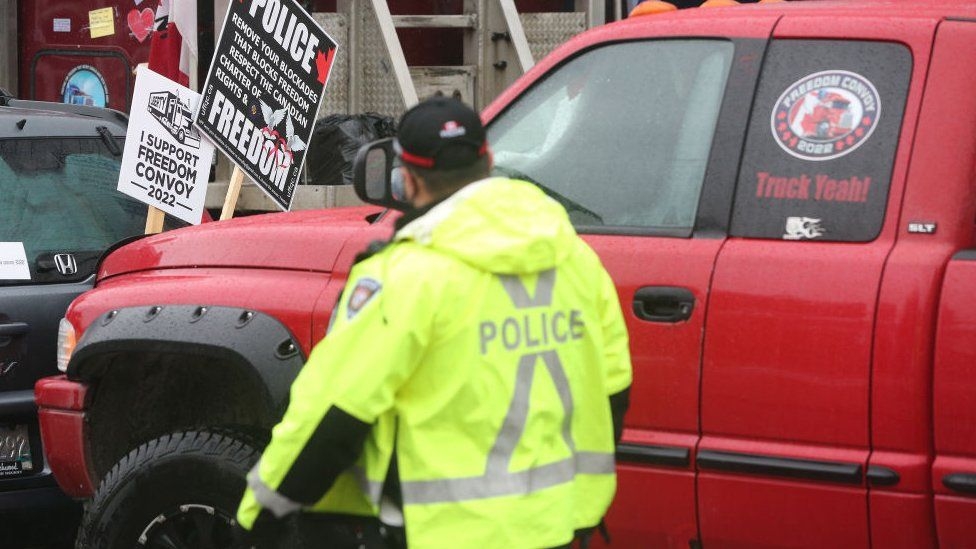
Police in the Canadian capital of Ottawa have warned that action is "imminent" as they prepare to clear a blockade of protesters in the city.
The demonstrators, many of whom have been in downtown Ottawa since late January opposing Covid restrictions, have been told to leave or risk arrest.
It comes days after the federal government invoked the never-before-used Emergencies Act.
The act imposes bans on public assembly in some areas, among other measures.
"If you want to leave on your own terms, now is the time to do so," Ottawa's interim police chief Steve Bell said on Thursday, addressing protesters.
Police have set up a secured area in Ottawa's city centre with almost 100 police check-points around the main protest site and a large business and residential section.
Only those with a "lawful" purpose to enter, like people living or working in the area, will be allowed in, excluding anyone intending to join the demonstration.
Protesters, many parked in some 400 heavy trucks and other vehicles on city streets around Parliament, have remained in Ottawa in defiance of orders to leave.
Mr Bell gave no specific timeline for when police might clear the site.
The police move comes before the weekend, when a core group of protesters who remain during the week are typically joined by thousands of other demonstrators on the streets of Ottawa.
"This weekend will be very different from past weekends," Mr Bell said.
On Thursday, Prime Minister Justin Trudeau defended his government's use of the emergencies law in the House of Commons, saying that invoking the act was "a last resort" necessary to end protests that he said threaten the national economy, public safety and US relations.
Opposition politicians accused Mr Trudeau of inflaming an already tense situation.
The use of the law is an "unprecedented sledgehammer", said Conservative leader Candice Bergen.
The Canadian Civil Liberties Association said on Thursday it would take the government to court over its use of the Emergencies Act to resolve the protests, calling the move "an extreme measure".
The protests began with a truck convoy heading to Ottawa to oppose a vaccine mandate for truckers crossing the US-Canada border, but eventually became about a broader opposition to pandemic restrictions and Mr Trudeau's government.
The Ottawa demonstration inspired protest blockades at various border points - which have since been cleared - that affected trade between the US and Canada, raising concerns from the White House.
The temporary emergency measures allow the deployment of federal and provincial law enforcement to assist local police with the Ottawa protest, which the government has deemed illegal.
They also include fines or prison time for participants who bring children to the protest site or who assist demonstrators with supplies like fuel or food.
Banks and other financial institutions - including credit unions and crypto-currency platforms - have been ordered to stop doing business with those associated with the protests and some bank accounts have already been frozen, Deputy Prime Minister Chrystia Freeland said on Thursday.
Truckers participating in the demonstration could see corporate accounts frozen and vehicle insurance suspended.
"The consequences are real and they will bite," Ms Freeland said.
Government officials have also said there are extremist elements present among the demonstrators and that the protests have become a "rallying point for anti-government and anti-authority" groups.
Four protesters arrested in connection with a border blockade in Coutts, Alberta, have been charged with conspiring to murder police.
Federal ministers have pointed to the indictments as indication of potentially dangerous elements within the wider demonstrations.
BBC

Russia's unmanned Luna-25 spacecraft has crashed into the Moon after spinning out of control, officials say.

Donald Trump has confirmed that he will not take part in Republican presidential debates with his rivals in the race for the White House.