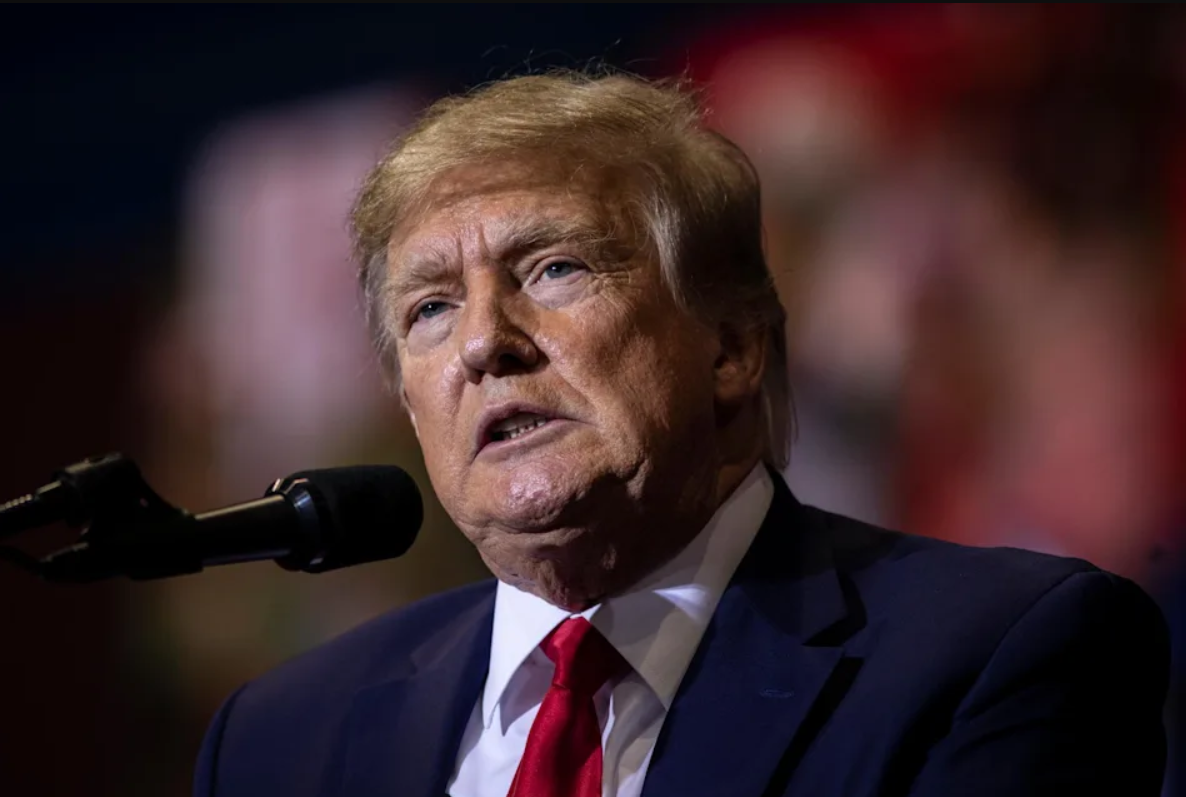
Donald Trump had cast this year’s primaries as a moment to measure his power, endorsing candidates by the dozen as he sought to maintain an imprint on his party unlike any other past president.
But after the first phase of the primary season concluded Tuesday, a month in which one-quarter of America’s states cast their ballots, the verdict has been clear: Trump’s aura of untouchability in Republican politics has been punctured.
In more than five years — from when he became president in January 2017 until May 2022 — Trump had only ever seen voters reject a half-dozen of his choices in Republican primaries. But by the end of this month, that figure had more than doubled, with his biggest defeat coming Tuesday when Gov. Brian Kemp of Georgia thrashed a Trump-backed challenger by more than 50 percentage points. Three other Trump recruits challenging Kemp allies also went down to defeat.
Sign up for The Morning newsletter from the New York Times
The mounting losses have emboldened Trump’s rivals inside the party to an extent not seen since early 2016 and increased the chances that, should he run again in 2024, he would face serious competition.
“I think a non-Trump with an organized campaign would have a chance,” said Jack Kingston, a former Georgia congressman who advised the first Trump presidential campaign.
Trump remains popular among Republicans and has a political war chest north of $100 million. But there has been a less visible sign of slippage: Trump’s vaunted digital fundraising machine has begun to slow. An analysis by The New York Times shows that his average daily online contributions have declined every month for the last seven months that federal data is available.
Trump has gone from raising an average of $324,633 per day in September 2021 on WinRed, the Republican donation-processing portal, to $202,185 in March 2022 — even as he has ramped up his political activities and profile.
Those close to Trump — and even Republicans who aren’t — caution against misreading the significance of primary losses in which he was not on the ballot. Kemp, for instance, took pains not to say a cross word about the former president to avoid alienating his loyal base.
“To be the man, you have to beat the man,” said Jim Hobart, a Republican pollster with Public Opinion Strategies. “And until Trump either bows out of electoral politics, or is beaten by a Republican at the ballot box, his strength remains.”
Rivals, including his own former vice president, Mike Pence, are gearing up for potential presidential runs, as he and others visit key early states like Iowa and ramp up their own fundraising operations. Gov. Ron DeSantis of Florida has amassed a $100 million reelection war chest and is the talk of many donors, activists and voters interested in the future of Trumpism without Trump.
“Donald Trump had four good years,” said Cole Muzio, president of the Frontline Policy Council, a conservative Christian group based in Georgia, who voted twice for Trump but is now looking for someone more “forward-looking.”
“DeSantis is great about seeing where the left is going and playing on the field that they’re going to be on, rather than reacting to what happened a couple of years ago,” Muzio said, echoing the frustration that Trump continues to obsess about denying his 2020 election loss.
Muzio, whose organization is hosting former Secretary of State Mike Pompeo as its fall gala headliner, spoke as he waited to hear Pence this week in Kennesaw, Georgia, at a rally for Kemp — all names he included in the party’s “deep bench” of 2024 alternatives.
Trump remains the most coveted endorsement in his party, and he has boosted some big winners. Sarah Huckabee Sanders in Arkansas virtually cleared the field for governor with his support, and Rep. Ted Budd in North Carolina defeated a past governor to win his party’s Senate nomination.
Yet the difficult primary season has added to Trump’s personal anxieties about his standing, after he has sought to fashion himself as something of an old-school party boss in his post-presidency. He has told advisers he wants to declare his candidacy or possibly launch an exploratory committee this summer.
Most of Trump’s advisers believe he should wait until after the midterm elections to announce a candidacy. Yet the sense among Republicans that Trump has lost political altitude is taking hold, including among some of those close to him.
Taylor Budowich, a Trump spokesperson, said the “undeniable reality” is that Republicans rely on Trump to “fuel Republican victories in 2022 and beyond.”
“President Trump’s political operation continues to dominate American politics, raising more money and driving more victories than any other political organization — bar none,” Budowich said.
Some Republican strategists have fixated on the fact that so many of Trump’s endorsees have landed about one-third of the vote — big winners (J.D. Vance in Ohio), losers (Jody Hice in Georgia, Janice McGeachin in Idaho and Charles Herbster in Nebraska) and those headed for a recount (Dr. Mehmet Oz in Pennsylvania).
One-third of the party is at once an unmatched base of unbending loyalists — and yet a cohort far from a majority.
Notably, Trump’s share of what is raised overall among all Republicans online has also declined. Trump’s main fundraising committee accounted for 19.7% of what was raised by Republican campaigns and committees on WinRed in the last four months of 2021 but just 14.1% of what was raised during the first three months of 2022. Some of that decrease is the result of other candidates on the ballot raising more this year.
Still, only 10 times since July 2021 has Trump’s committee accounted for less than 10% of the money raised on WinRed during a single day — and nine of those instances came in March 2022, the last month data was available.
The vocal opposition is no longer just confined to anti-Trump forces inside the party but is also evident in the pro-Trump mainstream. When a triumphant Kemp, whom Trump had targeted because he refused to go along with his efforts to subvert the 2020 presidential election, arrived in Nashville, Tennessee, on Thursday to speak before a gathering of the Republican Governors Association, he got a standing ovation.
“There is this temptation to engage in wish-casting in which, ‘This is the moment in which Trump is slipping!’” said Charlie Sykes, a conservative anti-Trump commentator. “On the other hand, what happened in Georgia was significant. He drew a bright red line — and voters just stampeded across it.”
Sykes said the current GOP very much remains “Trump’s party,” even as he saw a distinction developing “between Trumpism and Donald Trump himself.” The critical question, as he put it, is whether Republican voters are in a “let’s give him the gold watch and let’s move on” mood.
Pence, whom Trump publicly condemned as rioters swarmed the Capitol during the certification of the 2020 Electoral College vote, has made travels to early states. A favorite of evangelical voters, he has sought to highlight his support for ending abortion rights as the Supreme Court prepares for a possible decision undoing the landmark Roe v. Wade ruling.
Sen. Tom Cotton, R-Ark., who has been a hawk on immigration and China since before the Trump presidency, has positioned himself as a potential heir to Trumpism. Cotton has also drawn a contrast with Trump from the right, vocally criticizing the First Step Act — a criminal justice reform bill that the former president signed into law — as a liberal law.
Two former top Trump administration officials, Pompeo and Nikki Haley, a former United Nations ambassador, are making endorsements, traveling and building up their political infrastructure. Sen. Tim Scott of South Carolina recently announced another trip to Iowa and has been investing heavily in his digital fundraising operation.
Scott has said that this will be his last term in the Senate. But he continues to pad a $23.4 million campaign treasury despite facing only token opposition.Scott has more than 1,000 times as much as his closest rival, a Democrat with $23,199.
Even some Trump allies, like right-wing media host Steve Bannon, speak for a swath of one-time Trump voters when they condemn the coronavirus vaccines that Trump championed while president.
Yet if the primaries in May showed the bounds of Trump’s influence, they also made clear that his election-denialism movement has permeated the party. In Pennsylvania, Doug Mastriano, a leading voice against certifying the 2020 election, won the primary for governor in a landslide last week — even as the party’s old guard warned that he was too extreme to win in November.
Numerous Republican strategists have argued that Trump’s continued obsession with the 2020 election is an unwanted distraction in 2022, when Democrats hold the levers of power in Washington and polls show most of the country feels like the nation is moving in the wrong direction.
“The resounding message from the Republican voters in Georgia is: Quit talking about 2020,” Sen. Mitch McConnell, the Republican minority leader, told Politico. “And make the fall election about the future and about the Biden administration.”
In interviews with Republican voters at Kemp events, few had become anti-Trump. “We had a great four years with him: The economy was great; jobs were great; everything was great,” said Belinda Fickes, 49, a cafeteria manager outside of Atlanta.
But Fickes, who voted twice for Trump, is looking elsewhere in 2024. She lives in Cobb County, a suburban area that swung sharply away from Republicans in the Trump years. Hillary Clinton carried it by fewer than 8,000 votes in 2016; President Joe Biden won it by more than 55,000, far more than his winning margin in the state.
“He’s so polarizing,” Fickes said of Trump, “and that’s the problem.”
© 2022 The New York Times Company

Russia's unmanned Luna-25 spacecraft has crashed into the Moon after spinning out of control, officials say.

Donald Trump has confirmed that he will not take part in Republican presidential debates with his rivals in the race for the White House.