
Crimean and Russian flags fly above the Crimean parliament in Simferopol on Thursday. (Vasiliy Batanov/ AFP/Getty Images)
When President Viktor Yanukovych fled Kiev this week, it was tempting to assume that Ukraine's crisis was over: Euromaidan had won, and the forces of Western-style democracy had prevailed over Yanukovych's Kremlin-led repression.
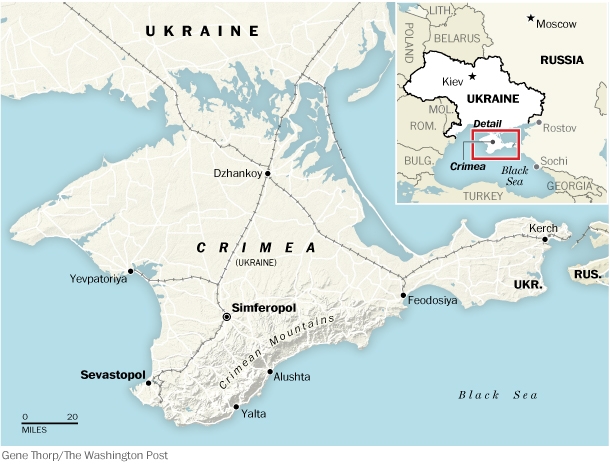
If only it were that simple. For the past few days all eyes have been on southern Ukraine's Crimean Peninsula, and things don't look so rosy. Crimea, which is not only populated by 60 percent Russian speakers but is the base of Russia's Black Sea Fleet, has seen some worrying developments in the past few days: On Thursday gunmenreportedly seized government buildings in the capital, Simferopol, barricading themselves in and raising Russian flags.
Crimea's situation is, as with many things in Ukraine's political crisis, compounded by a complicated history. For most in America and Western Europe, however, that history is likely obscure -- wasn't there a war or something there? Let's take a look back.
What even is 'the' Crimea?

It's revealing that Crimea is, much like Ukraine, often prefaced with a "the" when referred to in English. As I wrote late last year, the once-widespread use of "the Ukraine" has often angered Ukrainians, many of whom believe that the implication is that Ukraine is a region, not a country, that could be conquered by greater powers. The same logic could be applied to Crimea: For centuries the Crimean Peninsula, which occupies a strategically important location on the Black Sea and has arable land, has been fought over by various outside forces.
Before it was even known as Crimea, for example, the peninsula was known was "Taurica" by the Greek and Roman empires, both of which at points incorporated the region into their empires. These weren't the only outside forces that dominated Crimea, and at other points in its past it has been invaded or ruled by Gothic tribes, the Kievan Rus' state, the Byzantium empire and the Mongols, among many others. From the mid-1400s it existed as the Crimean Khanate, a protectorate of the Ottoman Empire, during which time it became the center of a roaring slave trade.
The modern name "Crimea" seems to have come from the language of the Crimean Tatars, a Turkic ethnic group that emerged during the Crimean Khanate. The Tatars called the peninsula "Qırım." While Russia, which annexed the state in 1783, officially tried to change the name back to Taurica, Crimea was still used informally and eventually reappeared officially in 1917.
In "The Tatars of Crimea: Return to the Homeland: Studies and Documents," Edward A. Allsworth explains that its name may been derived from the peninsula's strategically rugged landscape and may have meant "fortress" or "stronghold." If that's accurate, it's apt that Crimea is perhaps best known in the English language for the Crimean War, which began in 1853 and involved three years of bloody fighting between Russia and an alliance of the Ottoman Empire, France, Britain and Sardinia. While Russia eventually lost the war and Crimea suffered significant damage, it remained part of Russia.
The peninsula had a very tricky 20th century

German Panzer IV tank and soldiers in Crimea, 1942 (Bundesarchiv)
After the October Revolution ended the Russian Empire in 1917, Crimea briefly found itself a sovereign state. That didn't last long, however: It was quickly dragged into the Russian civil war, where it became a stronghold for the White Army. Following a succession of governments in a few short years, Crimea eventually became the Crimean Autonomous Soviet Socialist Republic in 1921, part of the Soviet Union. It remained like this until 1945, when it became the Crimean Oblast, an administrative region of Russia.
Like much much of the Eastern Front, Crimea's experience in World War II was incredibly traumatic: It was occupied by Nazi Germany, and the port city of Sevastopol was almost destroyed in the fighting. Once the Red Army retook Crimea in 1944, it forcibly deported the entire population of Crimean Tatars to Central Asia as punishment for collaboration with German forces. Almost half are believed to have died along the way. The Tatars, who had been on the peninsula for centuries, were not allowed to return to Crimea until the end of Soviet Union. They wouldn't forget their hardships, however.
With the Crimean Tatars deported from the peninsula, along with large numbers of Greeks and Armenians, Crimea was a very Russian place. Then, in 1954, something unusual happened: Russia gave it to Ukraine.
Why exactly did Premier Nikita Khrushchev transfer the Crimean Oblast to the Ukrainian Soviet Socialist Republic? In an informative post over at Slate, Joshua Keating picks up on a few possibilities. For one, the award of Crimea -- a strategically important place also great for agriculture -- was seen as a "gift" for Ukraine, whose people had suffered terribly during World War II. Peasants from Crimea could now be rewarded with land in Ukraine. Khrushchev, though Russian himself, had worked his way up through the Ukrainian Communist Party and likely felt a tie to the region.
It also probably didn't feel like a big deal at the time: Back in the days of the Soviet Union, the difference between Ukraine and Russia perhaps felt nominal. By 1991 and the Soviet collapse, things were obviously a little different. While many apparently expected new President Boris Yeltsin to demand that Crimea be returned to Russia, it never was. (As a side note, when hard-liners tried to force President Mikhail Gorbachev out in a coup in 1991, the Soviet leader was at his vacation home -- in Crimea).
When Ukraine held a referendum on independence in December 1991, 54 percent of Crimean voters favored independence from Russia. It was a majority, but the lowest one found in Ukraine. Following a brief tussle with the newly independent Ukrainian government, Crimea agreed to remain part of Ukraine, but with significant autonomy (including its own constitution and legislature and – briefly – its own president). In 1997, Ukraine and Russia signed a bilateral Treaty on Friendship, Cooperation and Partnership, which formally allowed Russia to keep its Black Sea Fleet in Sevastopol.
So why does this matter now?

Ukraine's language divide. Data source: 2001 national census. (Laris Karklis/Washington Post)
The Euromaidan protests have frequently been portrayed as a battle between the pro-European West and the pro-Russian East, a legacy of Ukraine's own history of Russian domination. That could be something of an oversimplification, sure, but it's an idea that resonates with many, both abroad and within Ukraine.
Given that Crimea has a modern history intrinsically linked with Russia, contains the largest population of ethnic Russians within Ukraine, and harbors a significant portion of Russia's navy in Sevastopol, Crimea is clearly an important place in that narrative. Add a minority Crimean Tatar population (12 percent in 2001) that has pretty good reason to be wary of Moscow, plus a lot of Ukrainians, and the situation could easily look explosive.
Of course, Crimea's history doesn't automatically mean conflict. While the Russian nationalists in Crimea have been given a lot of attention in the past few days, some say they aren't a coherent force. Ellie Knott, a doctoral candidate at the London School of Economics who conducts research in Crimea, has argued convincingly that the Russian nationalist and Crimean separatists are in practice hindered by their own internal divisions, and that many ethnic Russians in Crimea have a more complicated sense of national identity than might first appear. And while Russia has shown itself willing to get involved in the affairs of post-Soviet states, most recently with Georgia over the breakaway state of South Ossetia, few are predicting it will openly get involved in a dispute with Ukraine anytime soon.
If there's one thing you can say about Crimea's history, it's that it's been full of surprises. Its future might be, too.


