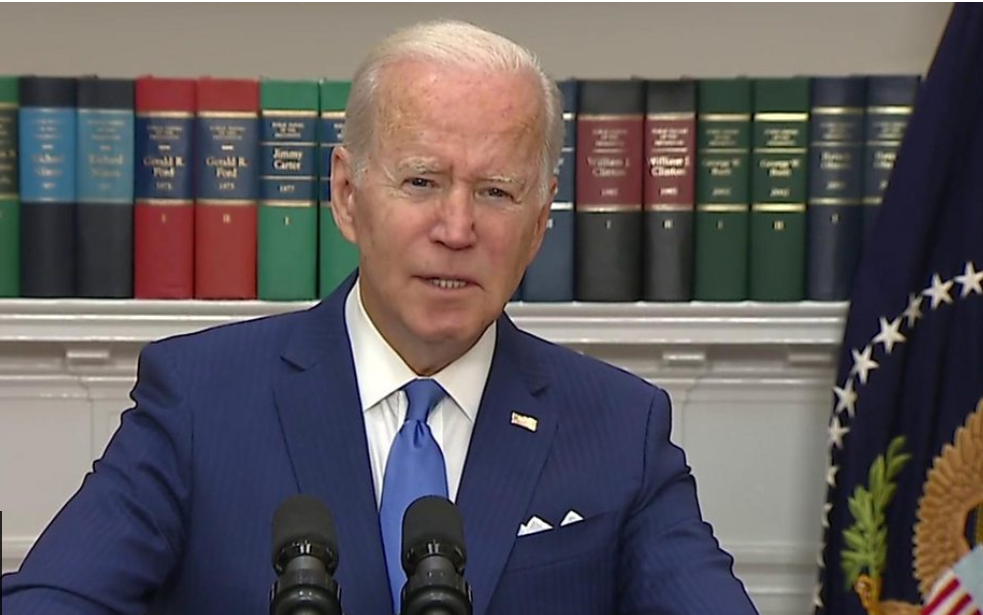
President Biden is asking Congress for $33bn (£27bn) in military, economic and humanitarian assistance to support Ukraine - although he insisted that the US was not "attacking Russia".
Mr Biden said it was "critical" for US lawmakers to approve the deal, which he said would help Ukraine defend itself.
The proposal includes more than $20bn in military aid, $8.5bn in economic aid and $3bn in humanitarian aid.
"It's not cheap," Mr Biden said on Thursday.
"But caving to aggression is going to be more costly if we allow it to happen."
Although the US has already announced help for Ukraine, the proposals are a significant ramping up of aid.
President Biden said US military support to Ukraine has so far amounted to 10 anti-tank weapons for every tank that Russia has deployed to Ukraine.
But despite his strong rhetoric, he said the US was not attacking Russia. "We are helping Ukraine defend itself against Russian aggression," he insisted.
On Thursday, a spokesperson for Russia's Foreign Ministry said Western military support for Ukraine threatens "the security of the continent".
In his speech on Thursday, Mr Biden also addressed concerns over a nuclear confrontation. On Wednesday, Russian Foreign Minister Sergei Lavrov warned of a "serious" risk of nuclear war over Ukraine which "can't be underestimated".
"No one should be making idle comments about the use of nuclear weapons," Mr Biden said.
Additionally, Mr Biden took aim at what he termed Russian "gas blackmail" to threaten European energy supplies. This week, Russia cut off gas supplies to Poland and Bulgaria.
"We will not let Russia intimidate or blackmail their way out of these sanctions," he said. "We will not allow them to use their oil and gas to avoid consequences for their aggression."
The announcement of the new Ukraine package comes at a difficult time for the US economy.
Data released by the Bureau of Economic Analysis on Thursday shows that the US economy shrank in the first quarter of 2022, with gross domestic product declining 1.4% between January and March.
But the package is likely to be approved by lawmakers, said BBC North America correspondent Anthony Zurcher.
"At a time when Biden is struggling to get congressional funding for his domestic priorities, Congress seems to have an unlimited willingness to bankroll military support for Ukraine," he said.
"Thirty-three billion is a significant amount, but if the past is any guide it should be approved with relative ease - as long as Democrats don't try to attach unrelated spending provisions to the legislation."
Mr Biden's first funding request after the war began, which was approved by Congress last month, was less than $14bn.
Last week, President Biden authorised a second $800m (£642m) military aid package in as many weeks, as well as $500m (£401m) in direct economic assistance.
The US has moved quickly to help Ukraine since the war began in late February. That includes:
- Releasing $3.7bn in military and security assistance
- Deploying more than 100,000 troops to Nato member countries in Europe
- Imposing economic sanctions, asset freezes and travel bans on hundreds of Russian oligarchs and politicians
The White House on Thursday also proposed making it easier for the US to seize and sell Russian oligarchs' assets, and transfer their proceeds to Ukraine.
Western allies, including European Union member states, have been working together since March to track down the assets of Russian elites, from artwork and real estate to helicopters and yachts.
According to the White House, the US has now sanctioned and blocked vessels and aircraft worth over $1bn, while the EU has collectively frozen over $30bn.
Thursday's sanctions would allow the US to use the funds from confiscated assets "to remediate harms of Russian aggression in Ukraine".
The package will "establish new authorities for the forfeiture of property linked to Russian kleptocracy, allow the government to use the proceeds to support Ukraine and further strengthen related law enforcement tools," the White House said in a statement.
Canada's government also proposed legislation this week that would allow it to seize and sell off Russian assets.
Under pressure to expand its sanctions actions, the ruling Liberals are pushing for "any type of property" including money, digital assets and virtual currency to be subject to seizure.
BBC

Russia's unmanned Luna-25 spacecraft has crashed into the Moon after spinning out of control, officials say.

Donald Trump has confirmed that he will not take part in Republican presidential debates with his rivals in the race for the White House.