US consulate: China orders US consulate closure in tit-for-tat move
24-07-2020, 18:21

Font size: [ A+ ] / [ A- ]


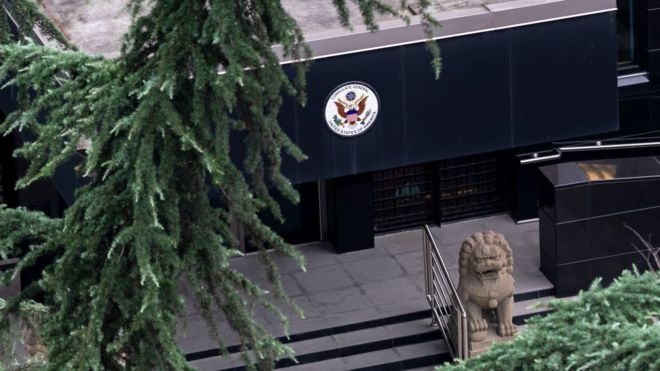
China has ordered the closure of the US consulate in the south-western city of Chengdu, in a tit-for-tat escalation between the two countries.

China said the move was in response to the US closing its consulate in Houston, and accused staff in Chengdu of meddling in its internal affairs.

Secretary of State Mike Pompeo said the US decision was taken because China was "stealing" intellectual property.

Tensions have been rising between the US and China over several key issues.

President Donald Trump's administration has clashed repeatedly with Beijing over trade and the coronavirus pandemic, as well as China's imposition of a controversial new security law in Hong Kong.

China's move came hours after Mr Pompeo hardened his tone further in a speech on Thursday at the library of former President Richard Nixon, whose 1972 China visit heralded a period of improved relations.

"Today, China is increasingly authoritarian at home, and more aggressive in its hostility to freedom everywhere else," Mr Pompeo said.

"The free world must triumph over this new tyranny."

On Friday, China's foreign ministry said it was closing the US consulate in Chengdu after staff there "interfered in China's internal affairs, and endangered China's security and interests".

During a news conference, ministry spokesman Wang Wenbin also said the US decision to close the consulate in Houston was based on "a hodgepodge of anti-Chinese lies".

He said Mr Pompeo's announcement on Thursday was "filled with ideological bias and a Cold War mentality."

"Pompeo made a speech in which he made a malicious attack on the Chinese Communist Party," Mr Wang said, adding: "To this, China expresses strong indignation and resolute opposition."

The ministry earlier said that the closure of the US consulate in Chengdu was a "legitimate and necessary response" to the actions taken by the US.

"The current situation between China and the United States is something China does not want to see, and the US bears all responsibility for that."

China has given the US until Monday to close the consulate in Chengdu, according to the editor of China's Global Times.

The mission, established in 1985 and currently having more than 200 staff - 150 hired locally - is seen as strategically important because it allows the US to gather information on the autonomous region of Tibet, where there has been long-running pressure for independence.

With its industry and growing services sector, Chengdu also is seen by the US as providing opportunities for exports of agricultural products, cars and machinery.

On Tuesday, the US government ordered China to close its consulate in Houston, Texas, by Friday.

The move came after unidentified individuals were filmed burning paper in bins in the building's courtyard.

Mr Pompeo accused China of stealing "not just American intellectual property... but European intellectual property too... costing hundreds of thousands of jobs".

"We are setting out clear expectations for how the Chinese Communist Party is going to behave. And when they don't, we're going to take actions," he said.

The Chinese consulate in Houston was one of five in the US, along with the embassy in Washington DC. It was not clear why it was singled out.

China's foreign ministry spokeswoman said the reasons given by the US for closing the consulate were "unbelievably ridiculous".

Hua Chunying urged the US to reverse its "erroneous decision", or China would "react with firm countermeasures".

In a further US move, four Chinese nationals have been charged with visa fraud for allegedly lying about their membership of China's armed forces - three are under arrest while the FBI is seeking to arrest the fourth, who is said to be in China's San Francisco consulate.

There are a number of things at play. US officials have blamed China for the global spread of Covid-19. More specifically, President Trump has alleged, without evidence, that the virus originated from a Chinese laboratory in Wuhan.

And, in unsubstantiated remarks, a Chinese foreign ministry spokesman said in March that the US military might have brought the virus to Wuhan.

The US and China have also been locked in a tariff war since 2018.

Mr Trump has long accused China of unfair trading practices and intellectual property theft, but in Beijing there is a perception that the US is trying to curb its rise as a global economic power.

The US has also imposed sanctions on Chinese politicians who it says are responsible for human rights violations against Muslim minorities in Xinjiang. China is accused of mass detentions, religious persecution and forced sterilisation of Uighurs and others.

Beijing denies the allegations and has accused the US of "gross interference" in its domestic affairs.

China's imposition of a sweeping security law there is also a source of tension with the US and the UK, which ruled the territory until 1997.

In response, the US last week revoked Hong Kong's special trading status, which allowed it to avoid tariffs imposed on Chinese goods by the US.

The US and UK see the security law as a threat to the freedoms Hong Kong has enjoyed under a 1984 agreement between China and the UK - before sovereignty reverted to Beijing.

The UK has angered China by outlining a route to UK citizenship for nearly three million Hong Kong residents.

China responded by threatening to stop recognising a type of British passport - BNO - held by many of those living in Hong Kong.


BBC


Comments: 242
#2   Linwood
      
BPC‑157 is a synthetic peptide that has gained attention in the medical
and athletic communities for its potential to promote healing across a wide
range of tissues, including muscle, tendon, ligament,
nerve, cartilage, and even bone. The compound is derived from a
naturally occurring protein found in the stomach,
which helps protect gastric mucosa and regulate blood flow.
While most studies have examined BPC‑157 through injection routes—particularly subcutaneous or
intramuscular delivery—there has been growing interest in an oral formulation that could simplify usage
for patients who need regular treatment or who prefer not to handle needles.


Oral BPC: Does It Work?


The fundamental challenge with peptides is their susceptibility to degradation by digestive enzymes and the acidic environment of the stomach.
Peptides
are large, hydrophilic molecules; when taken orally,
they typically break down into amino acids before they can reach systemic circulation. Researchers have therefore experimented with various strategies to protect BPC‑157 as it
travels through the gastrointestinal tract:


Encapsulation – Microparticle or liposome coatings can shield peptides from pepsin and hydrochloric acid until they reach a more neutral pH in the small intestine.


Protease inhibitors – Combining BPC‑157 with agents
that inhibit digestive enzymes may prolong its half‑life within the gut lumen.


Modified analogues – Chemical modifications such as N‑terminal acetylation or C‑terminal amidation can increase resistance to enzymatic cleavage.


Preclinical data from animal models suggest that certain oral
formulations of BPC‑157 achieve measurable plasma concentrations, albeit at lower levels than injectable preparations.
In a study using rodents with induced tendon injury, the orally administered peptide reduced inflammation and accelerated collagen deposition relative to placebo.
The researchers attributed this effect to both systemic absorption and local action within the gut mucosa, which may
release bioactive fragments that circulate systemically.


Human data remain sparse, largely limited to anecdotal reports from athletes and individuals using BPC‑157 for
recovery or chronic pain management. A few case series
indicate improvements in tendon healing time and reduced swelling after repeated oral dosing over several weeks.
However, these observations lack the rigorous controls of a randomized clinical trial, making
it difficult to separate true therapeutic benefit from placebo
effects or natural healing trajectories.


Because of the limited evidence base, most clinicians
remain cautious about prescribing oral BPC‑157 as
a first‑line therapy. Nonetheless, for patients who are unwilling or unable to receive injections, an oral peptide that shows
even modest bioavailability could provide
a meaningful alternative. Ongoing clinical trials will be essential
in clarifying dosage ranges, safety profiles,
and comparative efficacy against standard treatments.


Interested in learning more about Oral BPC?


If you would like to explore whether an oral BPC‑157 regimen might help with tendon repair, chronic inflammation, or general recovery, we encourage you to reach out for a free
consultation. Our licensed providers can discuss the latest research findings, assess your individual health profile, and guide you through potential treatment options.
Please contact us at your convenience; our team is ready to answer questions, provide detailed information on dosage protocols, and address any safety concerns
that may arise from long‑term use.


In summary, oral BPC‑157 represents a promising but still experimental approach to peptide therapy.

While early animal studies and anecdotal human reports suggest potential benefits, definitive evidence regarding its efficacy and optimal dosing has yet to be established
through large‑scale clinical trials. Those interested in pursuing this option should do so under the guidance of qualified medical professionals who can monitor for
adverse reactions and evaluate therapeutic outcomes over time.
7 October 2025 00:07
#1   Reyna
      
Ipamorelin is a synthetic peptide that has gained popularity among
athletes and bodybuilders for its ability to stimulate growth hormone
release without the side effects often associated with other growth
hormone secretagogues. While many users report increased muscle
mass, improved recovery times, and better overall vitality, it is essential to understand both the potential benefits and the possible negative side effects of
this compound.


Understanding Ipamorelin: Benefits and Side Effects

Ipamorelin works by mimicking ghrelin, a natural hormone
that signals the pituitary gland to release growth hormone.
The primary advantage is its selective action; it tends to
increase growth hormone levels without significantly raising prolactin or
cortisol, hormones often linked to undesirable side effects in other secretagogues.
As a result, users frequently experience enhanced protein synthesis,
increased collagen production, and improved joint health.


However, the safety profile of ipamorelin is not absolute.
Common mild side effects reported by users include localized pain at
injection sites, mild swelling or bruising, and occasional headaches.

Some individuals may notice a slight increase in appetite because ghrelin also stimulates hunger
signals. More serious but rarer adverse reactions can involve transient dizziness,
nausea, or feelings of fullness. In rare cases, people
with underlying endocrine disorders might experience hormonal imbalances that require medical supervision.


The risk of allergic reactions is present for any injectable peptide.
If a user develops rash, itching, or swelling beyond the
injection area, it may indicate an immune response that needs prompt evaluation. Additionally, long-term use
data are limited; some experts caution against extended
daily dosing because sustained growth hormone elevation could potentially affect insulin sensitivity and glucose metabolism.


Trusted. Verified. Peptides

When selecting ipamorelin, sourcing from reputable manufacturers is crucial.
Certified suppliers provide products that have undergone rigorous quality control,
ensuring purity and correct dosage. Look for third‑party testing certificates,
GMP (Good Manufacturing Practice) compliance statements,
and detailed ingredient lists. Avoid bulk purchases from unfamiliar vendors;
counterfeit or contaminated peptides can pose significant health
risks.


Proper storage also matters: ipamorelin should be kept refrigerated until use
and stored in a dry place to maintain potency.
Adhering to recommended injection techniques—using sterile needles, rotating sites,
and following the manufacturer’s guidelines—reduces the likelihood of adverse reactions such as infections or tissue damage.


You May Also Like

If you are exploring growth hormone secretagogues,
consider comparing ipamorelin with other peptides such as sermorelin, MK‑677 (ibutamoren), or growth
hormone releasing peptide 2. Each has a distinct profile in terms of efficacy and side effect spectrum.
For instance, sermorelin is often preferred for its longer half-life but may
cause more pronounced swelling at injection sites. MK‑677 offers oral administration but
can lead to increased appetite and water retention.


Beyond peptides, lifestyle factors significantly influence growth hormone levels.
Adequate sleep, high-intensity interval training, and a balanced diet rich in amino acids
all support natural hormone production. Supplements such as
arginine, ornithine, or glutamine may synergize with peptide therapy but should be used cautiously to avoid
overstimulation of the endocrine system.


In summary, ipamorelin presents a compelling
option for those seeking growth hormone benefits with
a relatively mild side effect profile. Nevertheless, users must remain vigilant
about potential adverse reactions, ensure their
peptide is sourced from verified suppliers, and consider integrating healthy habits that naturally complement hormonal balance.
6 October 2025 02:36
Add Comments

Name:*
E-Mail:
  Geo Keyboard  
 

Dear reader, guardian.ge welcomes your comments. Please express your views on topic and be respectful of others.

bold italic underline strike | align left centered align right | Ensert smilies insert linkInsert protected URL Choice the color | hidden text insert quote Convert selected text from transliteration to Cyrillic alphabet Insert spoiler

Code: *


Back1 ... 4 5 6 7 8 9 10 11 12 13 Next