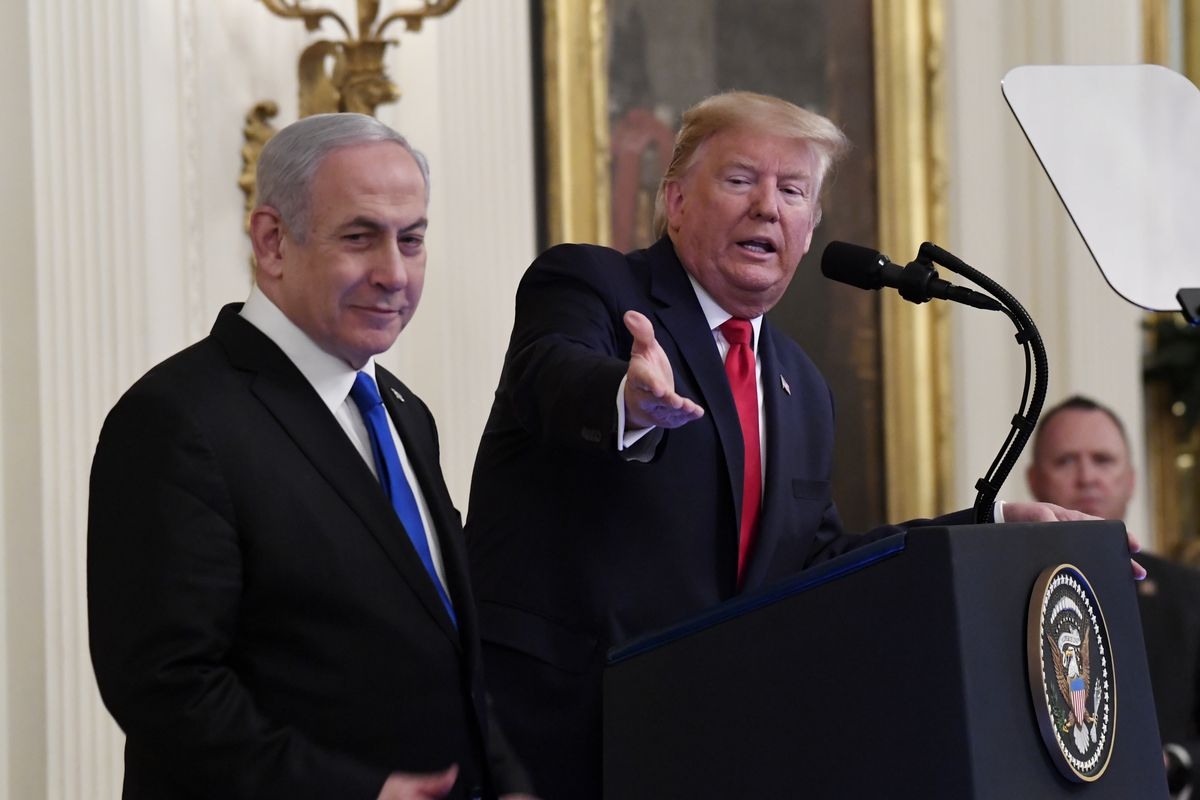
US President Donald Trump has presented his long-awaited Middle East peace plan, promising to keep Jerusalem as Israel's undivided capital.
He proposed an independent Palestinian state and the recognition of Israeli sovereignty over West Bank settlements.
Standing alongside Israeli PM Benjamin Netanyahu at the White House, Mr Trump said his proposals "could be the last opportunity" for Palestinians.
Palestinian President Mahmoud Abbas dismissed the plans as a "conspiracy".
"I say to Trump and Netanyahu: Jerusalem is not for sale, all our rights are not for sale and are not for bargain. And your deal, the conspiracy, will not pass," he said in a televised address from Ramallah in the West Bank.
The blueprint, which aims to solve one of the world's longest-running conflicts, was drafted under the stewardship of President Trump's son-in-law Jared Kushner.
Thousands of Palestinians protested in the Gaza Strip earlier on Tuesday, while the Israeli military deployed reinforcements in the occupied West Bank.
The joint announcement came as both Mr Trump and Mr Netanyahu faced political challenges at home. Mr Trump is the subject of an impeachment trial in the US Senate while the Israeli PM on Tuesday dropped his bid for immunity on corruption charges. Both men deny any wrongdoing.
David Friedman, the US ambassador to Israel, said that the timing of the announcement was not tied to any political development, adding it had been "fully baked" for some time.
Meanwhile, reports said Mr Netanyahu was planning to press ahead with annexing 30% of the occupied West Bank, with a cabinet vote due on Sunday.
More than 400,000 Israelis live in West Bank settlements. Those settlements are considered illegal under international law, although Israel disputes this.
Mr Friedman said Israel did "not have to wait at all" to move ahead with annexation.
What are Trump's key proposals?
"Today, Israel takes a big step towards peace," Mr Trump told officials and reporters at the White House.
"My vision presents a win-win opportunity for both sides, a realistic two-state solution that resolves the risk of Palestinian statehood to Israel's security."
His proposals are:
- The US will recognise Israeli sovereignty over territory that Mr Trump's plan envisages being part of Israel. The plan includes a conceptual map that Mr Trump says illustrates the territorial compromises that Israel is willing to make
- The map will "more than double the Palestinian territory and provide a Palestinian capital in eastern Jerusalem", where Mr Trump says the US would open an embassy. The Palestine Liberation Organisation (PLO) said Mr Trump's plan would give Palestinians control over 15% of what it called "historic Palestine".
- Jerusalem "will remain Israel's undivided capital". Both Israel and the Palestinians hold competing claims to the holy city. The Palestinians insist that East Jerusalem, which Israel occupied in the 1967 Middle East war, be the capital of their future state.
- An opportunity for Palestinians to "achieve an independent state of their very own" - however, he gave few details.
- "No Palestinians or Israelis will be uprooted from their homes" - suggesting that existing Jewish settlements in the Israeli-occupied West Bank will remain.
- Israel will work with the king of Jordan to ensure that the status quo governing the key holy site in Jerusalem known to Jews as the Temple Mount and al-Haram al-Sharif to Muslims is preserved. Jordan runs the religious trust that administers the site.
- Territory allocated to Palestinians in Mr Trump's map "will remain open and undeveloped for a period of four years". During that time, Palestinians can study the deal, negotiate with Israel, and "achieve the criteria for statehood".
"Palestinians are in poverty and violence, exploited by those seeking to use them as pawns to advance terrorism and extremism. They deserve a far better life," Mr Trump said.
He also indicated that the West Bank would not be cut in half under the plan.
"We will also work to create a contiguous territory within the future Palestinian state, for when the conditions for statehood are met, including the firm rejection of terrorism," he said.
Israeli officials said Mr Netanyahu would fly to Moscow on Wednesday to discuss the proposals with Russian President Vladimir Putin.
What reaction has there been?
In his address, President Abbas said it was "impossible for any Palestinian, Arab, Muslim or Christian child to accept" a Palestinian state without Jerusalem as its capital.
"We say a thousand times, no, no, no," he said. "We rejected this deal from the start and our stance was correct."
The militant Palestinian Islamist group Hamas, which controls the Gaza Strip, also rejected the deal which it said aimed "to liquidate the Palestinian national project".
The UN said it remained committed to a two-state solution based on the borders in place before the 1967 war, when Israel seized the West Bank and Gaza.
A spokesman for Secretary General António Guterres said the UN wanted a peace deal on the basis of UN resolutions, international law and bilateral agreements.
Israeli human rights group B'Tselem said the proposals envisaged a form of apartheid.
It said Palestinians would be relegated "to small, enclosed, isolated enclaves, with no control over their lives".
Israel's Peace Now organisation said the plan was "as detached from reality as it is eye-catching".
"The plan's green light for Israel to annex the settlements in exchange for a perforated Palestinian state is unviable and would not bring stability," it said.
British Foreign Secretary Dominic Raab urged the Palestinians to give the plans "genuine and fair consideration and explore whether they might prove a first step on the road back to negotiations".
What's the background?
The Palestinians broke off contacts with the Trump administration in December 2017, after Mr Trump decided to recognise Jerusalem as Israel's capital and move the US embassy to the city from Tel Aviv.
Since then, the US has ended both bilateral aid for Palestinians and contributions for the UN Relief and Works Agency for Palestine Refugees (UNRWA).
And in November, Secretary of State Mike Pompeo said the US had abandoned its four-decades-old position that Jewish settlements in the West Bank were inconsistent with international law.
The Arab League will convene an urgent meeting on Saturday.
What are the issues at stake?
Of all the conflicts in the Middle East, that between Israel and the Palestinians has been the most intractable. Although the two sides signed a breakthrough peace accord in 1993, more than a quarter of a century on the two sides are arguably as far apart as ever.
Jerusalem: Both Israel and the Palestinians hold competing claims to the city. Israel, which occupied the formerly Jordanian-held eastern part in 1967, regards the whole of Jerusalem as its capital. The Palestinians insist on East Jerusalem - home to about 350,000 of their community - as the capital of a hoped-for independent state.
Palestinian statehood: The Palestinians want an independent state of their own, comprising the West Bank, Gaza and East Jerusalem. Israeli prime ministers have publicly accepted the notion of a Palestinian state alongside Israel but not what form it should take. Benjamin Netanyahu has said any Palestinian state should be demilitarised with the powers to govern itself but not to threaten Israel.
Recognition: Israel insists that any peace deal must include Palestinian recognition of it as the "nation-state of the Jewish people", arguing that without this Palestinians will continue to press their own national claims to the land, causing the conflict to endure. The Palestinians says what Israel calls itself is its own business, but to recognise it as the Jewish state will discriminate against Israel's Arab population of Palestinian origin, who are Muslims, Christians and Druze.
Borders: Both sides have fundamentally different ideas as to where the boundaries of a potential Palestinian state should be. The Palestinians insist on borders based on ceasefire lines which separated Israel and East Jerusalem, the West Bank and Gaza between 1949 and 1967. Israel says those lines are militarily indefensible and were never intended to be permanent. It has not said where borders should be, other than making clear its own eastern border should be along the Jordan River.
Settlements: Since 1967, Israel has built about 140 settlements in the occupied West Bank and East Jerusalem, as well as 121 outposts - settlements built without the government's authorisation. They have become home to some 600,000 Israeli Jews. Settlements are considered illegal by most of the international community, though Israel disputes this. Palestinians say all settlements must be removed for a Palestinian state to be viable. Mr Netanyahu has vowed not only to never to uproot any settlements but to bring them under Israeli sovereignty.
Refugees: The UN says its agencies support about 5.5 million Palestinian refugees in the Middle East (the Palestinian Authority says there are up to 6 million), including the descendants of people who fled or were expelled by Jewish forces from what became Israel in the 1948-49 war. Palestinians insist on their right to return to their former homes, but Israel says they are not entitled to, noting that such a move would overwhelm it demographically and lead to its end as a Jewish state.

100 years of Israeli-Palestinian conflict: Key moments*
- Nov 2019: Trump administration says it no longer considers Israeli settlements in occupied territory as inconsistent with international law, putting the US at odds with most of international community
- Dec 2017: Donald Trump announces US recognition of Jerusalem as Israel's capital - Palestinians cut off relations with Trump administration
- April 2014: Last round of direct Israel-Palestinian peace talks collapse amid acrimony
- Sept 2000- Feb 2005: Second Palestinian uprising
- Sept 1993: Israel-Palestinians sign Oslo peace accords, agreeing framework for eventual peace deal; 20 years of on-off peace talks - and violence - follow
- Dec 1987-Sept 1993: First Palestinian uprising against Israeli occupation
- June 1967: Middle East war - Israel occupies East Jerusalem, West Bank and Gaza Strip; years of hostility and bloodshed follow; UN Security Council Resolution 242 calls on Israel to withdraw from "territories occupied in recent conflict" and recognises the right of "every state in the area to live in peace within secure and recognised boundaries"
- May 1948: British Mandate for Palestine terminates; Israeli statehood declared, Arab countries invade, conflict creates 700,000 Palestinian refugees; 800,000 Jews expelled or flee from Arab countries in wake
- Nov 1947: UN recommends partitioning Mandate Palestine into Jewish and Arab states - Jewish leadership in Palestine accept, Arab leadership reject; violence between two sides escalates
- July 1922: League of Nations entrusts Britain as Mandatory power to put terms of Balfour Declaration into effect
- Dec 1917: British forces conquer and occupy Palestine; in years that follow, violence between Jews and Arabs increases
- Nov 1917: Britain (fighting Ottoman Empire in WWI) issues "Balfour Declaration" expressing support for Jewish "national home" in Palestine on condition that the rights of non-Jewish communities there are not prejudiced
- Pre-1917: Turkish Ottoman Empire rules over Jewish and Arab communities in geographical area referred to as Palestine, the Holy Land or (by Jews) the Land of Israel.
BBC

Russia's unmanned Luna-25 spacecraft has crashed into the Moon after spinning out of control, officials say.

Donald Trump has confirmed that he will not take part in Republican presidential debates with his rivals in the race for the White House.