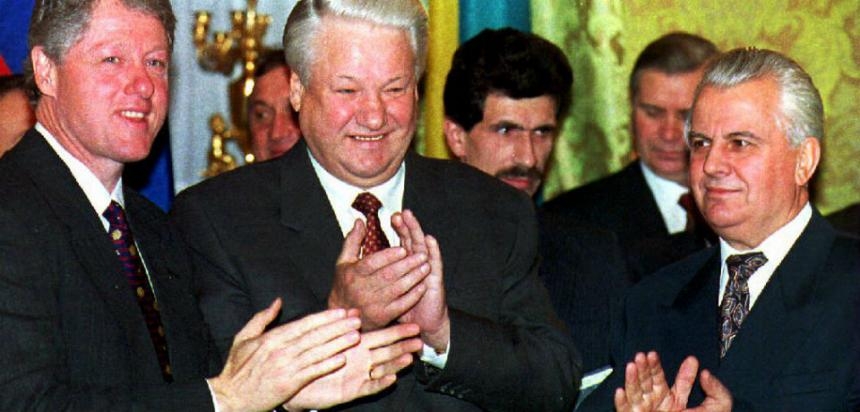
In 1994, Ukraine and Russian made a deal: Nukes for sovereignty. Moscow took Kiev’s 1,900 nuclear weapons. Now, 20 years later, it wants to take its sovereignty.
Against the backdrop of the crisis caused by Russia's military occupation of Crimea, Tuesday's flight-test of a Topol intercontinental ballistic missile (ICBM) was, to say the least, badly timed.
It also served as a good reminder that Ukraine, not so long ago, had the world's third largest fleet of ICBMs -- as well as the third largest nuclear arsenal. In 1994, Kiev agreed to hand over its nuclear stockpile to Russia for dismantlement in return for certain commitments, including to respect the former Soviet state's sovereignty. This agreement became known as the Budapest Memorandum of Security Assurances. And today, Moscow's actions in Crimea are in flagrant violation of those commitments.
When the Soviet Union collapsed in 1991, Ukraine housed 130 SS-19 ICBMs -- each capable of carrying six nuclear warheads -- in underground silos. A single SS-19 warhead had an estimated nuclear yield more than 20 times that of the bomb that leveled Hiroshima in 1945. In addition, 46 SS-24 ICBMs, individually capable of carrying 10 nuclear warheads, were deployed in central Ukraine, giving the country a total of 176 ICBMs. The newly independent country also inherited 44 Tu-95 Bear-H and Tu-160 Blackjack strategic bombers, as well as hundreds of Kh-55 nuclear air-launched cruise missiles to arm those aircraft.
Immediately upon its split from the Soviet Union in 1991, Ukraine had 1,900 strategic nuclear warheads -- a larger arsenal than those of Britain, France, and China combined.
Immediately upon its split from the Soviet Union in 1991, Ukraine had 1,900 strategic nuclear warheads -- a larger arsenal than those of Britain, France, and China combined.
In 1992, Kiev agreed to dismantle its strategic delivery systems, transfer the nuclear warheads to Russia for elimination, and accede to the Nuclear Non-Proliferation Treaty as a non-nuclear weapon state. The Ukrainians insisted, however, on certain conditions, including compensation, assistance for eliminating missiles and bombers, and security assurances. U.S. diplomats worked with their Ukrainian and Russian counterparts to broker a trilateral statement, signed by U.S. President Bill Clinton, Ukrainian President Leonid Kravchuk, and Russian President Boris Yeltsin in January 1994. It specified the commitments that the United States and Russia would undertake to address Ukraine's conditions.
The Ukrainian government attached particular importance to three concerns. First, Kiev insisted on compensation for the commercial value of the highly-enriched uranium in the nuclear warheads. Thus, the statement ensured that Russia would provide Ukraine with the equivalent amount of low-enriched uranium in fuel rods for the country's nuclear power plants, which generated 50 percent of Ukraine's electricity at the time.
Second, Ukraine lacked the resources to dismantle the missiles, bombers, and missile silos on its territory. The United States agreed to provide the Nunn-Lugar Cooperative Threat Reduction Program assistance to cover those costs.
Third, Ukraine asked for security assurances. The statement provided that, once Ukraine acceded to the Non-Proliferation Treaty as a non-nuclear weapon state, the United States, Russia, and Britain would undertake certain commitments for the independent Ukrainian state.
In December 1994, Clinton, Ukrainian President Leonid Kuchma (who succeeded Kravchuk), Yeltsin, and British Prime Minister John Major signed the Budapest memorandum, which committed the United States, Russia, and Britain "to respect the independence and sovereignty and the existing borders of Ukraine" and "to refrain from the threat or use of force against the territorial integrity or political independence of Ukraine." The agreement noted that "none of their [U.S., Russian, and British] weapons will ever be used against Ukraine except in self-defense or otherwise in accordance with the Charter of the United Nations."
The Budapest memorandum is a politically-binding agreement rather than a legally-binding treaty. Nevertheless, former Ukrainian officials in office at the time described it as crucial to Kiev's decision to give up nuclear arms.
When the four parties signed the memorandum in 1994, they agreed to meet should a nation feel that any of the commitments had been violated. For Ukraine, the violating country is, of course, Russia. And for the first time since the agreement was signed, Kiev has requested a meeting of the four nations.
Over the past week, Russian military forces have occupied Crimea, which Russia previously recognized as part of Ukraine. On Tuesday, March 4, Russian President Vladimir Putin denied that Russian forces have taken over the peninsula, asserting that "local militias" are manning checkpoints, blockading Ukrainian military bases and controlling Crimea's main points of entry. That claim defies credibility. Putin explained that the militias wore Russian-style combat fatigues because they could be purchased in army stores in post-Soviet states. (The reporters did not think to ask whether the Russian army jeeps and armored personnel carriers seen all around Crimea also could be purchased in those army stores.)
Russia has long based elements of the Black Sea Fleet and associated units in Crimea -- with Ukrainian agreement. Kiev has made no threats against those bases, and Ukrainian military forces on the peninsula have exercised great restraint. Moscow has no basis to claim self-defense and indeed has not invoked the right of self-defense. The Russian government, which normally insists that military action other than self-defense can be undertaken only with the approval of the U.N. Security Council, has not sought such approval. Instead, the Russian U.N. representative has been castigated by his counterparts for Russia's seizure of Crimea.
Given the violation of the Budapest memorandum, the Ukrainians invoked the commitment to consult. On Wednesday, March 5, U.S. Secretary of State John Kerry, British Foreign Minister William Hague and Acting Ukrainian Foreign Minister Andriy Deshchitsya met in Paris. Russian Foreign Minister Sergei Lavrov, although in Paris, chose not to attend.
Russian officials offered a novel defense for not carrying out the commitment to consult. They said that they had not signed the Budapest memorandum with the current government in Kiev. But the agreement is among the United States, Russia, Ukraine, and Britain -- not particular governments. Were this bizarre diplomatic logic applied more generally, states would have to again sign every agreement they have with another state when the latter changed its government.
The United States must live up to its Budapest commitments, if for no other reason than this is part of the price that Washington agreed to pay in 1994 to eliminate 1,900 strategic nuclear warheads and some 220 ICBMs and bombers that were designed to attack America. In the first instance, that means providing political support to Kiev and working with the International Monetary Fund and European Union on financial credits for Ukraine. Second, it means consulting with Kiev and the European Union to find a negotiating path to resolve the crisis. And third, it means coordinating with European and other countries to penalize Russia until it alters its behavior.
This is not just a question of living up to past U.S. commitments; it is a question of protecting the value of security assurances as leverage for resolving future proliferation challenges. It is possible, for example, that U.S. security assurances of some kind to Iran might play a role in finding a permanent settlement to the Iranian nuclear issue. But security assurances in the future will have little credibility unless the United States fulfills those that it undertook in Budapest.
SERGEI SUPINSKY/AFP/Getty Images

Russia's unmanned Luna-25 spacecraft has crashed into the Moon after spinning out of control, officials say.

Donald Trump has confirmed that he will not take part in Republican presidential debates with his rivals in the race for the White House.